While releasing a Triple-A title such as BioShock 2 in the immediate wake of the massive gaming event that was Mass Effect 2 may seem like a dangerous idea, it can’t be any worse for 2K Games than it has been for the number of movies released since “Avatar” came out. Was Mel Gibson in something recently? BioShock 2 is as different from Mass Effect 2 as any two shooters can be, and both games appeal to a certain kind of gamer aesthete who respects the originality and story-telling devices employed by both franchises. It still doesn’t make it any easier to play the one right after the other.
I would like to think that my view of and experience with BioShock 2 is unaffected by any other games I've played recently, so I have to assume the small letdown I felt playing it came from the game and the game alone. This second installment of what is one of the most original and intelligent games ever tries and succeeds at improving many aspects of the game, from elements of the action to the graphics and much more. But at the same time, it fails in being a better overall experience and advancing the universe in a way that should have us drooling for the next one. Not to unnecessarily compare them again, but that’s exactly what Mass Effect 2 did: leave me excited for the next one.
The concept behind the sequel, and where the gamermakers took the story after the twist ending of the first one, feels like a natural progression. The story of plane-crash survivor Jack wrapped up neatly in the first game, so following him again would have taken some plot-warping gymnastics or, even worse, a prequel. Switching the protagonist to a Big Daddy was a smart one, and it opens up the action to being something much more high-octane. It also gave the game’s developers an opportunity to explore a central theme of the game: the relationship between Big Daddies and Little Sisters. It’s mostly done well, though not with the same clever deftness of the first one. There is no huge twist at the end of BioShock 2, though there are plenty of unexpected moments peppered throughout. On its own, it’s a great game, and only thought of lesser when compared to the original.
Some elements are definitely not lesser. The shooter action that, like the first one, employs a combination of traditional(ish) firearms mixed with the spellcasting-like plasmid system is still great, and improved over the first one. Quickly transporting between different powers, different weapons and different ammo types is mostly easy, though the extremely scarce amounts of individual ammunition and the Eve-draining nature of the plasmids make sure you’ll have to switch frequently, especially during big fights. It would be nice to be able to set your weapons to automatically change ammo when you were out of a particular kind or even set your health hypos to automatically engage when your health gets low, but I’ll just put those on my wish list for the next game in the series.
That ammo scarcity can be a bigger pain when you realize just how important scavenging loot is from dead bodies, random cabinets and foot lockers. That collection system could also use some vast improvement, considering how muc time you’ll waste just cleaning out rooms for the basic necessities. The vending machines are plentiful, and the hacking system you use this time around is a lot better, giving you the opportunity to unlock something, reduce prices or even get a bonus item for free if you go for the harder hacks. That hacking element of the game, especially when it comes to turning security systems in your favor, is one of the best layers of BioShock 2’s action experience.
The biggest difference to the overall experience of fighting the crazed gene splicers comes from the fact that you are a Big Daddy in this game. Like in the first, getting control of the Little Sisters and thereby their Adam (the good way, by healing them, or the evil way, by harvesting them) is key to upgrading your powers and abilities. But since you are a Big Daddy, once you have a Little Sister, you can take her around on her Adam harvesting rounds, gaining even more of the precious gene juice. Once you do have the Sister start harvesting an “angel,” you’ll be charged with defending her while she completes her task. This plays out almost like a minigame, where you must defend the location from rampaging enemies—and you’ll need to take advantage of all of your weapons and plasmids, but especially traps and other defensive friends. You can drop traps, such as proximity mines and mini-turrets, and even string up electrical wires with your spear gun. The options are endless, and that’s one of the best things about the BioShock games in general: the endless flexibility.
As you play, you’ll discover all kinds of interesting combinations of plasmids and weapons to use in different situations. But I found myself gravitating to a few specific things over and over, somewhat to the detriment of other possibilities in the game. Anything that freezes an enemy, such as the Winter Blast plasmid or the Freezing Drill gene tonic, will be of a huge help, since frozen enemies take more damage and often end up shattering before their health is completely out. As well, anything electrical, such as the Electro Bolt plasmid, will do a lot of damage to enemies, as well as stun them. Considering all the standing water, too, it can be a great area attack as well.
All that wetness is a key element to the setting this time around. The underwater city of Rapture isn’t much different than in the first game, although you’ll be traveling through much different areas, including outside of the city on the ocean floor. You’re a Big Daddy…it’s what you are meant to do. But the trademark art-deco style is still on display, punctuated with the scratchy old music from some lost phonograph, though the whole thing now seems to be well on its way to being completely swallowed up by the ocean itself. There are barnacles and coral and seaweed growing almost everywhere. You can practically smell the rot.
The makeover that the game has received in this sequel works in some places and not others. The multiplayer mode feels anything but tacked on, and offers up some pretty exciting action, thanks to its adherence to the plasmid/guns/melee fundamentals of the single-player game. It plays a bit differently, mostly because you’re not dealing with the issues of resources like you are when you’re in the Big Daddy suit in single player, but the core gameplay really comes out. It’s fun, and different, but I fear that it will hardly attract the kind of online community that Modern Warfare 2 or any of the other shooters that trail far behind it in number of online players will. It’s a hard thing to break into, Xbox Live popularity. I hope for the best for BioShock 2’s multiplayer, but I think it’s going to need to do something really different to break through.
Despite not liking it as much as in the first game, the story in BioShock 2 is nonetheless compelling. Exploring the bond between Big Daddies and Little Sisters is something the series needed to do, since it’s one of the most fascinating components of the universe. The addition of the Big Sisters only adds to the complexity, as well as the difficulty of the action, and I can only imagine what they could continue to do with them in the rest of the series. There is no twist in this game on the same scale as the first one’s, but you will still be shocked at the game’s climax, and the ensuing couple of levels will be of great interest to you if you’re invested in the world of Rapture. In fact, the last hour or two of this game are among the most exciting and compelling game finishes I’ve played in a while.
The original BioShock is a hard game to top, and BioShock 2 doesn’t quite do it. That doesn’t mean it isn’t one of the best games of this still early year, or that it won’t still be considered to be one of the best come year’s end. Where the series goes from now is hard to tell, but there are some elements of the game that will need to significantly change to avoid going stale. But BioShock 2 remains one of the most original, exciting, subversive and intriguing shooters out there for you to play, and you shouldn’t miss the experience of doing that.
What with videogame worlds getting bigger and bigger, it's no surprise that we get correspondingly excited whenever someone comes up with a new way to lob ourselves across them - whether it's jumping between rooftops in Crackdown, zooming along Halo in a Banshee, or swinging around the crumbling remains of Ascension City like Tarzan meets Robocop in Bionic Commando. If we're going to commute between the fun, better to do it in style.
And although it takes a while to comprehend, Bionic Commando's swing mechanic is very stylish. As you fall from the rooftops you make a grab for lampposts, jutting girders and carved-up monorail by compressing the left trigger as they flash past, firing out a grappling hook from your bionic arm and slingshotting smoothly beneath at a matching pace, before releasing to send yourself in a preferred direction. Maximum respect goes to the programmers behind the context-sensitive icon that shows where you can hook on, because the distances are intuitively consistent, and with a bit of application the learning curve flattens out and you're able to manoeuvre swiftly and impressively, and catch yourself when you brush up against the limitations of your own dexterity.
But then, of course, Crackdown wasn't really about jumping between rooftops, and Halo wasn't about zooming around in a Banshee, so Bionic Commando can't afford to be about protagonist Nathan Spencer's impressive Spider-Man antics alone. Instead it's most frequently about a succession of fights that call upon different areas of Spencer's expansive arsenal.
On the basic end, he has a pistol and grenades, which you can apply with typical if not particularly great effect. More elaborate weapons, like a multi-firing rocket launcher that locks onto multiple enemies as you tag them with the probing reticule before release, and grenade launchers and sniper rifles, are provided by support pods fired into the city, but the enormity of their influence is mediated by a shortage of ammunition. Handily though, Spencer gradually recalls other things he can do with his bionic arm, like whipping or punching wreckage across the landscape, and latching onto enemies with his hook before reeling in to deliver a kick to the face - the latter even more handily rebounding you into the air for a follow-up.
There's enough of a toolbox there to enforce experimentation, and the menagerie of beastly biomechanical monsters often has you rummaging around. Gorilla-like berserkers are susceptible at the rear and if you can penetrate their facial armour, but close the gap to the player at dangerous pace, forcing you to work quickly if you're limited to smacking them with the scenery, and to reach for stun moves like 'death from above', which allows you to clatter to ground with dizzying force. The aerial polycraft flyers keep their distance, wary of damaging zip-kicks, and the less animalistic but no less predatory human snipers have you dancing between their visible sighting lasers as you struggle for cover and tactics. A range of mini challenges (with corresponding Achievements) gives you new ideas, too.
But it's when the more interesting battles are brought together with the swing that Bionic Commando stands out, as when you're dodging snipers in the industrial district (and later as you work through the park), trying to maintain aerial momentum to evade the beams. My favourite though was a battle with a Buraq helicopter on top of a skyscraper, where the exposed steel framework creates a jungle-gym or potential manoeuvres and the threat of the chopper's machineguns and backup polycraft compel you to make use of it. By the time you have secured enough rocket launcher rounds to outdo your hawk-like aggressors, you know you've been in a fight.
Not that the game tries to leave you in any doubt about that once it gets going. The plank-brained grunts of the terrorist occupation force are barely worth the more elaborate ends you can put them to, but when they're reinforced by machinegunners, or deployed in greater numbers, they're sufficiently pesky to kill you. And it's in this way that developer GRIN aims to regulate the difficulty level: more enemies! Checkpointing is generally only worth the odd grumble, but there are a few real spikes, including a very frustrating battle in the FSA Archives building late on, where the enemy force goes through several waves of fiddly projectile-spitting fodder, which comes off as cheap - especially as it's merely the filling between not being able to access something and suddenly receiving authorisation. What tactical depth should be available is neutered by density.
Less frustrating, but more surprising, is that Bionic Commando never goes properly open-world, preferring a halfway house that offers freedom as far as the eye can see and then a slow radioactive death to dissuade you going any further. You're forever working your way to the next yellow checkpoint icon on the mini-map, which is often a relay beacon that disables aerial minefields, opening up the way to the next waypoint. There are a few hidden 8bit capsule-toy style icons to uncover per area, but between the orienteering and frequent load screens you come to accept that this is a corridor action game - it's just that the corridors are broad and nicely decorated.
And this they are, and only occasionally to the detriment of the frame-rate. Ascension City may be on its last legs (if not knees, or slumped over in a pool of its own effluent), but it's as imposing as Crackdown's Pacific City and as detailed, and in its haunting desolation and abandonment, almost as characterful as GTAIV. The haze is sometimes off-putting, and I do wish we didn't have to go inside or underground so much, but the water, lighting effects and sheer scale are achievements, particularly in areas like the glass-domed park and cavernous fissure running beneath the city.
There's variety too, as illustrated by the diversity of multiplayer playgrounds for the eight-player online games, within which you can gather for deathmatch and CTF variants. As you may have discovered in the recent Xbox Live demo, however, it's a dangerous place to tread if you're still a novice with the bionic arm, and a rudimentary lobby system also does a poor job of recommending it. Where it ultimately falls down though is in the relationship between players, which can't match the battles between a fully tooled Spencer and increasingly overpowered, Capcom-spec enemies in the single-player campaign.
By the time I reached the end of that campaign, I was experiencing mixed emotions. GRIN has certainly taken the load off combat boots wearied by too many open worlds with great effect, but although you travel over rather than along them, they are still highways of debris passing beneath your feet, and all you are doing is pausing occasionally to dispatch the people you meet and consult the A-to-Z. The result, though stylish and engaging, is something rather more primitive than the more enjoyable battles - where the bionic swing and core combat work in closest collaboration - really deserve. Bionic Commando succeeds in resurrecting a good idea lost to the Capcom archives, and giving it a new lease of life, but it falls foul of a few old standards in the process.
In Battlefield: Bad Company, no one is safe. Not a sniper hiding inside a tower. Not a soldier driving a massive tank. And definitely not you, as you bob and weave across a fiery sandbox of destruction. If you thought the action of the Battlefield franchise was intense before, you haven't seen anything yet. Thanks to a fleshed-out single-player campaign, Battlefield's trademark multiplayer action, and a new level of destructibility, Bad Company is quite simply one of the most fun shooters released this year.
Sweetwater and Haggard entertain themselves, and you, with a little rock-paper-scissors in between firefights.
With its Frostbite engine, Dice has created a warzone that is almost completely destructible. Nooks and crannies that were once a safe haven in other shooters can be reduced to rubble with a well-placed tank shell or mortar strike. Is a quaint Russian home standing between you and an objective? Blow a hole in a wall and walk right through. The system is not perfect since not all buildings can be completely destroyed. Some materials like brick may crumble to dust, but wood crates will often withstand whole missile strikes. Frostbite has its foibles, but Bad Company still gives new meaning to breaking and entering.
A good place for new players to enter is Bad Company's single-player campaign. That's right, a Battlefield game has a bona fide single-player campaign and not a collection of multiplayer maps littered with AI bots. You play as Private Preston Marlowe, recently reassigned to the 222nd Battalion, B Company, which is a collection of misfits and castoffs that the Army likes to send into battle first. B Company, in short, is expendable. You complete a four-man squad composed of Sergeant Redford, a grizzled veteran who volunteered for B Company so he could retire early; Sweetwater signed on to take advantage of a college scholarship without realizing he may actually have to fight; and Haggard is a country bumpkin and demolitions expert who loves to blow stuff up. Together, you'll fight your way into Russian territory and take out a number of well-guarded installations. When the Army leaves you stranded behind enemy lines--something about plausible deniability--the squad goes AWOL in search of mercenary gold. Along the way you'll rescue a flamboyant dictator that resembles Saddam Hussein on ecstasy, and then make your escape in a pimped-out gold chopper. No, the story isn't exactly the stuff of Stephen Ambrose, but the tongue-in-cheek humor and numerous unlockables scattered throughout the campaign make it worth fighting.
Marlowe is a jack of all trades and can handle any of the weapons and vehicles in Bad Company. Often he'll be in control of a mortar strike or laser designator that can lay waste to entire villages. The designator is meant to be used on heavy armor, but it's hard to resist dropping 50-ton bombs on lone troops just for the heck of it. There's a short recharge time so you don't inadvertently start World War III here, but you'll never get tired of unleashing explosive mortar strikes on our foes.
Your squadmates are full of friendly chatter during the campaign, but they never die and don't work together very well at times. Whereas multiplayer requires you to coordinate with your teammates, single-player feels as if you're truly playing alone, with three characters in the background that only list new objectives and provide a little comic relief. They'll take out a few enemies, man turrets and take cover, but you're doing the bulk of the work. This wouldn't be so much of an issue if friends could jump online for a little co-op, but there's no option to do so unfortunately.
Enemy soldiers are not exactly the sharpest bunch and some have no problem standing in the open, waiting for their own demise. Luckily there are so many enemies and objectives that the game never feels easy, but the firefights would be even more intense if enemies more frequently made use of cover, if only so you could blow it up. Marlowe comes equipped with an automatic health injector that refills your life bar and can be used over and over again after a short recharge. Is stabbing yourself in the heart with this panacea any more unrealistic than regenerating health as seen in Call of Duty 4 and Rainbow Six Vegas? Not really. But it certainly feels cheap plunging that needle into your chest every 20 seconds during an intense battle, something you'll surely do toward the campaign's final few missions that border on ridiculousness. You would think that four Army oddballs versus an entire mercenary force and Russian army equipped with tanks and attack choppers wouldn't stand a chance, but you would be wrong, thanks to the handy health injector.
When you've got the hang of the weapons and gadgets of the single-player campaign, jump into Bad Company's excellent online multiplayer mode. It's called Gold Rush, but it's really just a basic attack and defend mode in which an attacking team tries to blow up crates of gold. If you're successful, a larger portion of the map opens and the attackers push forward to do it all over again. This has been done before in other games, but no one does it better than Bad Company, thanks to absolutely massive maps that support 24 players, a vehicle list that includes tanks, jeeps, choppers, boats, and Humvees, as well as laser-guided rocket turrets and artillery cannons. There are five character classes in multiplayer and each has its own special abilities and unlockable extras that will make you giddy. The specialist can lace enemy vehicles for demolitions experts--their rockets will automatically hone in on tagged targets. The sniper can utilize the laser designator to nullify tanks, and the specialist can drop med kits, repair vehicles, and call in mortar strikes.
It's strange that the conquest mode in which teams vie for points on the map and drain enemy tickets, a mainstay of the Battlefield franchise, is absent. The mode will purportedly be made available as a free download at some point, but it should've been in the game right out of the box. That said, you're not likely to get bored of Gold Rush anytime soon. The maps are perfectly balanced with defensive turrets and offensive weaponry, and often matches are decided by the smallest of margins. This is the kind of game where you call your friends to let them know you somehow sniped an enemy chopper pilot or dropped a missile on the final gold crate on a map for the win. The game would've benefited from more vehicles; there aren't nearly as many on each map as you find in Battlefield 2, so teammates will often fight over fun toys such as choppers. But with its persistent ranking system and unlockable weapons, Bad Company is surely the most addicting multiplayer shooter since Call of Duty 4.
Unlock the laser designator in multiplayer to drop guided bombs. The best part? You do the guiding.
Be sure to crank the volume up to 11--Bad Company has some of the finest sound design out there. A sniper shot echoes perfectly through the mountains, while indoor firefights are so loud you may want earplugs. Visually the game does not fare as well. While it's by no means ugly, there is a strange graininess on each texture. Even looking into the clear blue sky in the first scene of the game, you'll be amazed at how fuzzy it looks. Of course, the destructible environments and exciting explosions make up for any graphical shortcomings.
Battlefield Bad Company is the most fun, addictive shooter released so far this year. While far from perfect, the intense sandbox warfare is something that you have to experience. Dice calls it tactical destruction. We call it explosive fun.
In the world of comic book videogames there is always one factor that will make or break the title in question; letting the player feel like their favourite hero. Spider Man 2: The Movie (the game), Hulk: Ultimate Destruction and the more recent X-Men Origins: Wolverine are perfect examples of this. Each one featured some sort of game mechanic that provided players with a means to endless satisfaction through web-swinging, smashing and lunging. This is also the reason why games like Superman Returns, Ironman and the majority of Batman games to date have died on their collective arse. Putting the player in control of a much-loved hero is all fine and dandy, but the second the in-game persona does something that brings them out of character and into the realms of ‘video game protagonist X’, the magic is lost and we’re left with a generic slog that fails to provide any sort of insight into the character at hand. It’s why (and I’m throwing down the gauntlet here) a Superman game will never work – because there’s almost no discernible way to provide players with the true power of Superman in a game world. Batman, however, is just a man.
Far more suited to a videogame scenario, it’s difficult to understand just why it’s taken so long for a developer to bring us a truly well-made Batman game. It probably has something to do with all of the others being lazy knocked together cash-ins of films and cartoons, which is amusing when you consider the untapped potential of the years and years of Batman comic books and graphic novels. Rocksteady are a studio that understand the failings of Bat-games gone-by. Instead of piggy-backing on the success of the Christopher Nolan films or the popular animated series ‘The Batman’, the developer has turned away from the safety net of Hollywood tie-ins and kept their roots buried firmly within the realms of Detective Comics. Whereas Spiderman, Hulk and Wolverine were all great fun, they played more like tech demos in a brightly coloured costume more than anything. Granted, two of those games were based on films anyway, but even so – none managed to really convey any meaningful insight into the characters, their history and their psyche.
Arkham Asylum changes all of this. For once a developer has taken a much loved franchise and made every effort to explore what makes it so special. Taking inspiration from a number of Batman writers and artists, Arkham Asylum is a culmination of years of Batman stories, fused together with an original plot penned by Paul Dini, creator of Batman: The Animated Series. It begins with Batman capturing the Joker and returning him to Arkham, at which point the Joker springs free, releasing the inmates (not to mention an alarming amount of Batman’s worst enemies), so beginning a night of torment for the Dark Knight. To summarise it in such a short sentence doesn’t do justice to the attention to detail on display. The first ten minutes of the game is spent walking the Joker, straight jacket and all, through the Asylum’s prisoner transfer areas, providing a glimpse of things to come. The care that has gone into recreating the Asylum is second to none, and walking through the gothic architecture, listening to the conversations of guards and cell-bound inmates creates a scarily believable atmosphere.
It’s this atmosphere that carries the game from start to finish. There’s never a moment in which the setting feels like anything other than the Asylum often described in Batman comics. The murky halls of the penitentiary, and the disturbingly primitive Victorian medical centre are bursting with character. Each area is unique and serves a purpose, and every room seems to have a certain individuality, the developers not falling back on the typical cookie cutter design that’s so often apparent in videogames. Not since Bioshock’s Rapture has there been such a lavishly detailed environment, that enforces the grim and disturbing narrative simply through it’s dark aesthetic. It’s a fitting location for a Batman story, and even more so for a Batman game. Having been locked into the Asylum with every loon under the sun, the game becomes an insight into the relationship between the Joker and the Batman, with Joker narrating Batman’s movements about the island, toying with him as he goes.
For the most part Batman has to deal with Joker’s thugs rather than anyone of any real threat. In fact to begin with it can almost seem too easy, until you realise that it’s supposed to be that way. To make the player really feel like Batman, Rocksteady have created a simple but deceitfully deep combat mechanic that utilises a minimal number of buttons to cause a great deal of damage. When fighting crowds of unarmed henchmen, it only takes a single button tap and a direction from the analogue stick to start dealing out blows. When an enemy attacks, a tap of the counter button reverses the move, and on it goes. At first it seems to be little more than tapping the face buttons until everyone is unconscious. But as the game progresses, new types of enemies armed with knives and shock-rods demand a change in tactic, requiring the use of evade manoeuvres, cape swishes and some of Batman’s more interesting toys. Sustaining a combo (the higher of which the more XP Batman will gain to unlock more cool stuff) while fighting twenty men soon becomes an art form. No longer is it simply a case of hitting the buttons in a rhythmical fashion, it’s about looking for the next victim, creating distance, pre-empting strikes and managing the crowd.
The animation on display makes this even more noteworthy. When put into motion, the freeflow system is a thing of absolute beauty. Every punch and kick moves from one to the next flawlessly. If an enemy comes up behind Batman with a kick, Batman will grab the leg under his arm and sweep the guy to the ground. As Batman moves through crowds of people he does away with them with ease and more importantly with style, creating an effortless ballet of sickening blows. It’s the sort of spectacle that makes watching someone play it almost as fun as playing it yourself. The ease with which Batman can take thugs down reinforces the idea that he is a highly trained martial artist. It makes sense that he’d have no trouble dealing with two-bit thugs and so although it remains easy to some extent, it develops Batman as a character, adding to the game experience rather than detracting from it.
Similar to this is the Silent Predator mode. In rooms stuffed full of bad-guys with guns, stealth is the only way Batman can survive. As mentioned previously, he’s just a man – and it only takes a few bursts of gunfire before seeing the game over screen. Firing his grapnel gun up to the rafter-based gargoyles however and Batman can survey his enemies movements. From here there are all sorts of possibilities. Gliding down and kicking a guy in the face, finishing him off and then grappling back up out of harm’s way is the type of swift decisive action expected from Batman. As the other thugs discover the bodies, they start to panic, making it easier to catch them out, whether it be with a sneaky batarang from behind a corner, or swooping from above and stringing them upside down from a gargoyle. Although it’s easy to take them out with a prompted silent take down, should Batman get close enough while unseen, making a noisy impact then slipping out of view is more likely to strike fear into the remaining enemies – making them scream in terror, and jump at the slightest noise. It becomes more than simply clearing a room of bad guys, it’s about messing with their heads, and is scarily enjoyable.
Of course, it wouldn’t be as obvious just how terrified they are were it not for Batman’s detective vision. A type of visual effect that shows up points of interest in the world, along with NPCs’ current condition (alive, unconscious, scared etc). Alongside this are actual sections of detective work, Rocksteady not wanting to overlook the fact that Bruce Wayne/Batman is the world’s greatest detective. These consist of little more than scanning a room for a clue (for example, a hip flask) waiting for the computer to identify the alcohol particles in the air, and following them in detective vision. It’s simplistic, and in videogame terms little more than a ‘go to’ line, but due to the nature of the story and the events at hand it comes across as much more than that. You are Batman, and you are on the trail of something big. The fact that it makes what would in most other games be little other than an objective marker into an interactive part of the game is simply icing on the cake.
The thing with Batman: Arkham Asylum, is that there’s so much icing on the cake that it’s hard to know what to eat first. Every nook and cranny oozes class, it’s been a long time since there’s been a game polished to such an extraordinarily high degree. Every little detail has been carefully designed to fit within this living breathing world, and around every corner is another opportunity to discover something new about the Batman world. The island is littered with challenges left by The Riddler, that can be attempted at any time. Each one encourages further investigation into the next, often resulting in extended periods of time hunting down clues rather than trying to foil the Joker’s plans. There are numerous interview tapes scattered about, each one scripted and voice acted with such high production values, that finding one is enough to cause great excitement. On the subject of voice acting, the two lead roles of Batman and Joker – performed by Kevin Conroy and Mark Hamill – are absolutely superb. Hamill especially steals the show with his performance as the psychotic, yet hilarious Joker in what could actually be his greatest performance of all time.
Amongst all of these superbly executed elements there are constant references to Batman villains past and present, brilliant little nods to certain novels and characters that will constantly surprise diehard fans, as well as acting as a sort of ‘education in Batman’ for newcomers. Then there are the numerous references to Batman’s past, the clever way the developer delves into what makes Bruce Wayne who he is, and why he does what he does. The theme of fear runs throughout the game and acts as a sort of fundamental element to which everything grows from, further emphasised by certain characters that bring about the notion of terror in a breathtaking manner. It seems impolite to dwell on the few instances of what aren’t bad, but simply average game mechanics that slip in to the game later on, and while the final fight may well be a bit of an anti-climax, it’s only for the rest of the game being so undeniably excellent.
Rocksteady have proven that they’re a company that really care. They actually ‘get’ Batman, they’ve looked at the character from every conceivable angle and strived to make this everything anybody could possibly want from a Batman game. It’s an adult presentation of an adult character, and not once does it fail to make the player feel anything other than the Dark Knight himself. At one point last year Ian Livingstone, head of Eidos, made the bold statement that Arkham Asylum was the closest thing to a perfect game they’ve ever made. After multiple play-throughs and constant replaying of challenge rooms (that encompass freeflow and silent predator challenges outside of the main game) I can honestly say that while it isn’t the perfect game, it’s the closest you’ll ever get to being Batman.
I'm not a huge fan of hunting, despite being born and living in the south for most of my life. Still, that didn't stop me from finding a bit of fun in Bass Pro Shops: The Hunt, a game that accurately (I would guess) presents the feeling of tracking and hunting an animal in the wild almost entirely without making the activity feel tedious. While that certainly doesn't mean that this game is for everyone, I think that hunters looking for a virtual recreation of their favorite pastime will find things to enjoy.
The setup to the game is very similar to Bass Pro Shops: The Strike in that there are introductory missions to teach you how to use all of the tools at your disposal before you set out into the wilderness to fend for yourself. Thankfully for The Hunt, this game doesn't rely on a wash, rinse, repeat mechanic like The Strike did. Instead you'll have to use a large assortment of equipment to lure in or stalk your prey from afar. The annoyance of having to adhere to certain hunting guidelines (like targeting a specific type of deer in a forest filled with other animals) is still present, much like it was in The Strike, but the experience is more rewarding on land than it was on water.
Bass Pro Shops: The Hunt Gameplay - Turkey Hunt
That's not to say that there aren't plenty of annoyances to be found within The Hunt. For starters, the game is technically not up to par. The relatively open environments in each of the game's locales are constrained greatly by wonky physics and a method of travel that doesn't exactly lend itself to smoothly moving from point A to point B. There were even a few instances where I got stuck on trees and I'd then have to trek the remaining miles of my journey on foot. One such instance even featured my ATV getting stuck on nothing at all -- it just wouldn't budge.
Graphically the game also has its fair share of issues. By that I mean it sort of looks like crap. The wilderness has more jaggies than I've seen in some time and the framerate positively chugs at points. The one shining star in The Hunt's sea of ugliness is the sky which manages to look fairly striking at times. Of course that doesn't mean that there's any sort of day/night cycle. I have a feeling that asking this game to change its lighting in-game would spell certain disaster.
Aside from the standard, long-winded hunting adventures that are sure to take you hours to complete, there are also mini-games to keep your attention. You'll find gun ranges and races for you and a friend to compete in, but unlike The Strike, you can play most of these (not racing) with a friend alongside you. I recommend the Duck Hunt mini-game purely for nostalgia's sake.
As the snow melts and the temperatures rise, one thing is sure to pop into the minds of boys everywhere: baseball season! Backyard Sports: Sandlot Sluggers allows players to join their favorite neighborhood friends and play ball in fun and exciting arcade style sports action. Sandlot Sluggers is a completely new take on a longtime favorite franchise with all-new features, updated graphics, enhanced gameplay, and extensive options that will keep players and gamers alike enthusiastically entertained.
Backyard Sports: Sandlot Sluggers offers hours of entertainment with laugh out loud comedic commentary and exaggerated animations for a one-of-a-kind gaming experience. The game is packed with loads of surprises and stars a neighborhood full of fun and diverse kids -- both fan favorite characters and new friends.
Every one of my Sundays between mid-August and early February consists of waking up at or around 11am, catching the pre-pre-game and the pre-game show, and lazing out by watching almost 11 hours of grown men pummel each other to bits all while attempting to carry, throw and kick a ball into and towards the opponent's goal area.
When a Nintendo64 happened to appear underneath my Christmas tree way back when, the game that had a near-permanent residence in the cartridge slot was Madden 64. Of course, all subsequent iterations in the series became automatic purchases as well, rationalised as doing my civic duty, supporting the sport created by Americans, for Americans. It's a sport with the chutzpah to take the universally known moniker of "football," as in soccer, and redefine it for us Yankees.
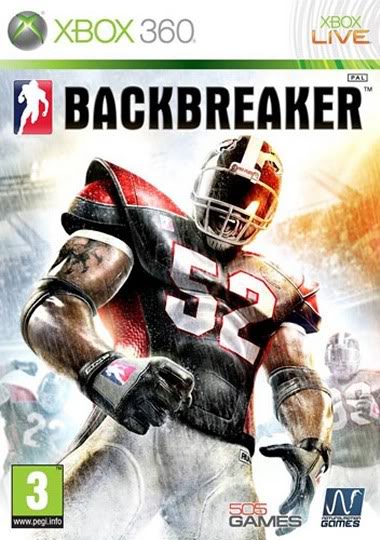
With that said, Backbreaker is a passive attempt at recreating the spirit of the sport on a gaming console. The atmosphere and gameplay - save for the use of NaturalMotion physics - are non-existent, the controls are all over the place, and P.O.D.'s Here Comes the Boom, the official song of every single kick-off, plays so often you'll want to go OJ Simpson on your game unit.
It's also a shame that the judicial proceedings challenging the NFL's exclusivity deal with Electronic Arts are taking so long to shake out, because Backbreaker could have used some of the League's well-established motifs (and real players!) to bring some colour to the action. Alas, you're left to play what amounts to an exhausting, half-baked experiment with features, for the most part, done better by the Madden series.
That's ironic, because during the game's development cycle Backbreaker's makers have effervesced with pride over their nascent creation, saying that it would finally take Madden down a notch and usher in a new generation of football games relying on the NaturalMotion physics engine - which, for the most part, is actually an interesting feature.
Players are no longer subject to a limited number of canned animations that eventually become repetitive. Like snowflakes, each tackle is different and, during my review sessions, delivering and receiving unique crushing blows was the best part of the whole experience. There is a future for this technology in sports gaming and hopefully other developers will take a long look at it in future, if they haven't already.
However, upon further examination things begin ripping apart at the seams. The Training Camp mode is a near-mandatory stop because Backbreaker uses a wholly different control set than what you'll find in the Madden series. Instead of using your controller's buttons, the majority of your players' actions will be controlled by transitioning in and out of "focus" and "aggressive" modes which increase their speed and throw accuracy and allow them to absorb hits to keep on slugging along the pitch. For example, your quarterback in focus mode will be able to lead and hit his receivers better, but the camera closes in on the action and increases his blind spot.
Unfortunately, this also happens on the defensive side - which is ridiculous considering, for example, that a corner must be able to see more of the field to execute their defensive strategy better, not less. Furthermore, the action on the field is fast and furious, making the need to fumble around with entering and exiting modes to keep up impractical.
[Correction: Since this review was published, it has been pointed out that this section is unclear and could be misleading. When playing defense, it is "aggressive mode", not "focus mode", which causes a narrowing of the view. It was the need to switch between these two modes which our reviewer found impractical when playing defense. -Ed.]
Even giving the game the benefit of the doubt with this strange control system, there's always the ability to change camera angles. Right?
Sorry, pal: you're locked into a third-person view for whichever player you are controlling. You will often find yourself trying to fight over a block while a play unfolds on the other side of the screen. Even with the ability to change to a relevant player (i.e. the ball carrier or defender), I easily became disoriented long enough to miss any chance at making a play on the ball. Football is certainly a game of inches and in the virtual world, it's also a game of valuable split seconds. Backbreaker does not accommodate.
Of course, all could be forgiven if playing the game was actually fun. Sadly, the feature set is anorexic. Along with the Training Camp, you can play through two separate, but essentially equal, career modes called Season and Road to Backbreaker. Season Mode is the standard pick-your-team-and-win-the-title endeavour with very light managerial aspects thrown in, like scouting and roster editing. Road to Backbreaker is more of the same, but you'll get the chance to create your squad from scratch and pit it against up to 32 other teams.
Aside from the game's physics engine, Backbreaker can at least hang its hat on incorporating a thorough creation engine in Road to Backbreaker. You can pick team colours, edit the team logo and even choose how many star players you want. OCD creators rejoice: with enough time you can pretty much replicate anything under the sun, if the rest of the game hasn't turned you off completely by that time.
[Correction: This section also requires clarification. Teams created with the team creation engine are not restricted Road to Backbreaker mode, but can be used in Season mode, too. -Ed.]
Thankfully, playing football isn't the only thing you can do in Backbreaker, because an expanded version of the iPhone's Backbreaker Tackle Alley can also be found in this console version. The basic gist is that you must manoeuvre your lone ball-carrier across the field as increasingly dangerous waves of defenders come hurtling toward him. As addictive as it was on a mobile, Tackle Alley on a console controller lacks tactility, making pulling off jukes (left or right on the right control stick) and spins (a half circle on the right stick) an exercise in frustration.
I was often oh-so-close from reaching the end zone when, instead of spinning, my player juked and was demolished by an oncoming defender. Nevertheless, there are 100 waves to challenge yourself against and the game dangles the ability to unlock additional teams to use as a reward. (Oh great, more football teams.) You can also play Tackle Alley with or against a friend online, along with regular exhibition games. From the few games I was able to find and play, the experience is no different than playing solo, except for a few hiccups due to lag and disconnections.
But don't be fooled by such mitigating novelties: at its core, Backbreaker is a soulless attempt at straddling the fence between the over-the-top action found in the Blitz series and trying to accurately simulate the sport of football like the competition. For every amazing tackle and crushing blow that the NaturalMotion physics engine pops out, there is an equal and opposite debilitating occurrence that the developers willingly included, in good faith of course. Unfortunately, playing Backbreaker just reaffirms the quality effort, no matter how incremental in updates it may seem from year to year, that EA puts forth with each year's Madden.