Monolith Productions developed a love it or leave it title for the launch of Xbox 360 last year by the name of Condemned: Criminal Origins. While some loved the eerie presentation, others couldn't get past the slow melee combat. At the same time, and using some of the same development tools and assets, Monolith was also putting together a game for the PC called F.E.A.R. This critically acclaimed game had all of the spooky atmosphere of Condemned with some phenomenal AI, intense action and excellent graphics and sound. A year later, F.E.A.R. has found its way to Xbox 360 courtesy of Day 1, maintaining the excellent atmosphere and fast-paced combat giving console shooter fans the opportunity to experience one outstanding game.
F.E.A.R. starts off with a simple enough story. As a First Encounter Assault Recon member, you're sent in to investigate a man named Paxton Fettel who has a taste akin to Hannibal Lector. Since you've got reflexes that are "off the charts" you can employ a SlowMo bullet time power to help you get the drop on enemies that will cause you great headaches. This thin premise for having superpowers also provides reason to send you in alone. As is the case in these games, things don't go smoothly once you're on your own. You quickly jump into a paranormal quest to learn what exactly led to this strange turn of events and how you can put a stop to it.
While the story is passable, the method of delivery leaves something to be desired. Aside from very brief in-engine cutscenes that happen at the beginning of some of the levels, the story comes to you mainly through searching through the various buildings and offices for blinking lights on phones or laptop computers. Accessing these will fill you in on some of the details, but it is entirely auditory and oftentimes you'll merely get fluff for your exploratory efforts.
The game isn't really about the story though. With a cheesy acronym staring you in the face from the get-go, you might expect as much. It really is more of an amalgamation of three methods of game delivery; puzzle, combat and scare sequences. The puzzles are there just to break up the action and allow you to keep your sanity. The scare and combat sections, though, can match up with the best of them.
Take that Sam Fisher...oh wait.
One of the real strengths F.E.A.R. has is that it is genuinely scary, something you won't often find even in the so-called "survival horror" games. Whether the scare tactic is the classic startling image quickly popping up, grotesque dismembering of unfortunate souls, or lights being played with just to mess with you, you'll find your fight or flight response at full tilt. We've had numerous people in the office who have had to stop playing F.E.A.R. from the horror getting too intense and it has become somewhat of a running gag to sneak up on someone playing and scare them from behind.
The graphics and sound in F.E.A.R also work amazingly well together to draw the player into the world. Turn the lights off, crank up your surround sound and pop the game in on a cold and rainy night and you'll see just what we mean. The great use and absence of lighting along with constant eerie sounds will keep you wondering what might lie ahead. These intense sensory experiences do a fantastic job of drawing you into the game and making you forget that you're playing a game with some somewhat questionable premises. It all builds up to F.E.A.R having you so engrossed in the game that when the fright does come, it hits home.
The fantastic AI present in the PC version has made its way over to the console world intact. Enemies come in squads and react to their environment, your actions and each other. They'll advance when they have numbers, kicking over bookshelves to create their own cover along the way. Kill a couple of them and they'll pull back and call for backup. Try to hide in a corner while your SlowMo gauge refills and you'll find a grenade bouncing to your feet. On the other hand, rushing out into the open will cause the entire squad to stand up and start firing away with their automatic weaponry. It all boils down to the enemies feeling real as opposed to simply following scripted actions as we've see so often.
Armored Troopers will not go quietly.
This AI provides for some seriously intense battles where you'll be relying on your SlowMo reflexes in a desperate hope for survival. To fight back, you're given a nice selection of weapons that each behave differently and enable you to approach battles with the right tools for your playing style. The shotgun is useful throughout the game and to back it up you've got weapons that range from the standard pistol, to repeating cannons, to the devastating sniper-like particle cannon. The effects of these weapons are nothing but extreme gore. Enemies shot in the right place will have arms, legs or even their heads blown off. That is, of course, if the impact doesn't make them explode into a cloud of blood and guts. Nothing beats firing a giant stake into an enemy's head and watching it impale them on the wall as their body dangles lifelessly below.
The only real drawback to the campaign mode is the somewhat repetitive scenery. While most of the game takes place in dimly lit rooms and halls, what you can see is almost exclusively office spaces and construction zones. It can get tiring and was a major turn-off for many people who played through the PC version. One of the other slight disappointments in the game, its length, actually mitigates the issue somewhat. The game can be finished in roughly 10 hours so you'll be done with the campaign before you really get tired of what you're seeing. Another note about length: There are four levels of difficulty in F.E.A.R. and Day 1 set most of the Achievements quite high. Playing through on the hardest difficulty level will gain you the most Achievement points, but it will be tough.
This review may seem like treading over old news if you've played through F.E.A.R. on the PC, so we'll get to what has been changed and added. The instantly recognizable additions are the new Instant Action mode and bonus mission. The Instant Action mode puts you into pure combat situations in environments drawn from various parts of the campaign mode and scores you on a variety of factors including enemies killed, health packs in your inventory and accuracy. At the end, you can post your score on the Xbox Live Leaderboards to see just how well you stack up against the world. Separate scoreboards exist for each difficulty level and can be sorted to see who has posted the best score in the past week as well as all time. This mode is pure fun and great for seeing how the AI will react differently depending upon how you approach a situation. This addition greatly extends the shelf life of a game that has an otherwise relatively short single player mode. The same can't be said about the bonus mission. While we're not complaining about more missions, this one is fairly short and just allows you to play out a short bit of side story and try your hand at some tough combat.
I think you got him.
A new machine pistol is present, as well, but anybody who has played F.E.A.R. knows that the shotgun is the best way to go through the bulk of the campaign mode. Those who have played F.E.A.R. will notice a few more subtle tweaks that enhance the gameplay in a much better way than the simple addition of a new weapon, cool though it may be. Everything that was loose in F.E.A.R. on PC has been tightened up for the console release. While the rag-doll Havok-induced physics present some fantastic death animations, the engine was a little too loose on the PC and you often found downed enemies shaking on the ground after you killed them. On the PC, we found that a simple melee attack aimed at a dead enemy's head would cause it to spin in a most inhuman fashion. All of this has been tidied up for Xbox 360. While you still get some awe-inspiring death animations as bodies go tumbling through the air or simply explode, objects appear to have a slightly more realistic weight to them.
The controls are obviously different from the PC, but they map to the 360 controller quite well. The stick sensitivity has been turned down from the much faster default setting on the PC to one that is much tighter enabling you to aim with accuracy. The sensitivity can be changed through the menu if you find the defaults aren't to your liking. You can also adjust the button configurations between five different options, though there isn't any way to play with a southpaw or legacy setup.
F.E.A.R. on PC forced you to make full use of the quick save option since you never knew just when you were going to run into another fight. The save anywhere feature has been dropped for the console in lieu of a checkpoint system. The checkpoints work perfectly as they're positioned slightly prior to or just after major action sequences. Thus death doesn't mean replaying long stretches of the game.
The multiplayer side of F.E.A.R. plays in much the same way as it did on PC. There are a few new maps, but the game modes are the same. Those are your standard deathmatch, capture the flag, and elimination (along with team variants of each). The other mode unique to F.E.A.R. allows one person to control the SlowMo by maintaining possession of a booster with the penalty of becoming highlighted on everyone else's HUD.
Paranormal happenings abound.
The multiplayer game is set for up to 16 players, though you'll only be able to play one person per console. There is no co-operative mode and you can only take one person online at a time. There also isn't any system link option, so if you're without an Xbox Live account you're out of luck for multiplayer action.
Still, F.E.A.R. multiplayer on Xbox 360 maintains many of the customization options that PC gamers typically enjoy, such as the host's ability to adjust winning conditions, running speed, weapon restrictions and even point rewards and penalties for specific actions. Turning the running speed up to 1.5 makes the game move in a hectic Quake-like manner and brings the action to a level close to total insanity. We're fans, made even more so by the lack of lag during our online experience with the retail copy.
F.E.A.R.'s multiplayer is fun and has some excellent options for tweaking the game, but it has a serious hiccup in the lobby. That being the lack of a post-game lobby. As soon as you finish a game, you'll be kicked back out to the menu screen without so much as a chance to say goodbye. This happens even on unranked matches where you are presumably playing with friends making it more than a little frustrating to get into an extended online session with some buddies. When asked about any plans to update this, we were told that none were in the pipeline as of yet.
Caerful, there's a little bit of broken glass.
As we've stated before, the graphics are a sight to behold. Although the environments are repetitive, a great attention to detail is present that brings the world to life. Everything looks realistic with great models and textures, making the imagery that much more disturbing. The lighting keeps you in the dark, pun intended, as to what you'll come across next. It encourages you to explore nooks with your flashlight in hopes of finding just one more health pack. The lighting also adds enough to the atmosphere to keep you on the edge of your seat and isn't just there for looks. You'll find many of the lighting tricks help add to the sense of impending danger that comes so often throughout F.E.A.R.
If the graphics are good, the sound is exceptional. Put this game in a home theater that can handle 5.1 surround sound and you have one great auditory experience. Trickling water, droning bass, and giant explosions that come out of nowhere break the silence in ways that will suck you into the game and then quickly shake you out of your trance. Even the generic elevator music you'll hear periodically throughout the game hits you in a way that is oddly unsettling. F.E.A.R. was the runner-up to the IGN PC Channels award for "Best use of Sound" last year with good reason; and it all holds up on Xbox 360.
So long World War II. Hello modern warfare! Call of Duty has made the leap from the heroics of the greatest generation to a horrifying vision of the future in CoD4, and the results are pretty darn spectacular. The single-player campaign is filled with tight gameplay and great moments you’ll want to play again and again, and the multiplayer is some of the deepest and most satisfying around. Call of Duty 4 is a great game that is highly recommended.
Quick Hits
* Title: Call of Duty 4: Modern Warfare
* Platform:Xbox 360
* Publisher: Activision
* Developer: Infinity Ward
* ESRB Rating: “M” for Mature
* Genre: FPS
* Pros: Great presentation; fun single-player filled with amazing moments; solid multiplayer
* Cons: Same ol’ (good) Call of Duty gameplay but with a new skin; no co-op
Gameplay
From a gameplay perspective, Call of Duty 4 feels pretty much like CoD2 and 3. The controls are the same, and other things like the grenade danger indicator are all present and accounted for. One area where CoD4 is a bit different is that it seems to be much faster paced than the previous games in the series. Thanks to a very generous lock on system where you can just tap the left trigger and your gun automatically moves to the next target (this can be turned off if you want), you can clear buildings and power through firefights extremely quickly. Personally, I really like this because it makes you truly feel like a badass. You are playing as a fully trained and highly skilled soldier, and the gameplay really makes you feel like one. It is absolutely a thrill to enter a room and kill three guys in less than three seconds with precision bursts. The whole game is just smooth and easy to control and absolutely satisfying.
""Activision
Single-Player
The Call of Duty games have always had great single-player experiences, and CoD4 is no different. It clocks in at only 6-7 hours, but it is filled with amazing moments that are going to be absolutely worth replaying. You play as a few different characters through the game, but you are always a member of a small but highly trained squad that can get in, do their job, and get away safely. You cover a lot of fairly varied terrain, and the straight up FPS shooting is broken up with vehicle gunner segments, quiet mission where stealth is the key, and a couple of sniper missions that are probably my favorite two missions in any FPS ever. It also needs to be noted that your AI squadmates are actually really smart and really skilled and can more than hold their own.
Multiplayer
As good as the campaign is, the Xbox Live multiplayer is where you will probably spend most of your time if you are a hardcore FPS fan. It comes with plenty of maps and game types for up to 18 players, and you can choose from a ton of options to make the game play pretty much how you like. CoD4 is more of a slow paced, Rainbow Six or Ghost Recon style of game rather than the run and gun style of Halo and isn’t going o be as immediately accessible for players. It is far more satisfying in the long run for dedicated players than Halo, however, thanks to the experience and perk system that rewards you with new skills and abilities the more you play. All in all, CoD4 is a blast to play online that offers some of the deepest and most rewarding multiplayer you’ll find.
Graphics and Sound
Without a doubt, Call of Duty 4 is one of the nicest looking games on the Xbox 360. The environments are really the stars of the show here, and the battle damaged cities, building interiors, forests, and grassy fields all look realistic and great. The lighting effects are also spectacular and really set everything off.
The sound is also impressive all around. Great music, great sound effects, and mostly great voice acting make CoD4 a treat for the ears as well as the eyes.
Bottom Line
Call of Duty 4 has been in the works for a long time at Infinity Ward, and all of the effort has definitely been worth it. It has a fantastic single-player campaign, a fun and deeply rewarding multiplayer game, and wraps it all up in some of the best graphics and sound on the Xbox 360. My only real complaint is that there is no co-op play. The campaign is so fun and exciting and having a friend along for the ride would have made this already great game truly exceptional. That issue aside, Call of Duty 4: Modern Warfare is a fantastic game that is highly recommended for a purchase.
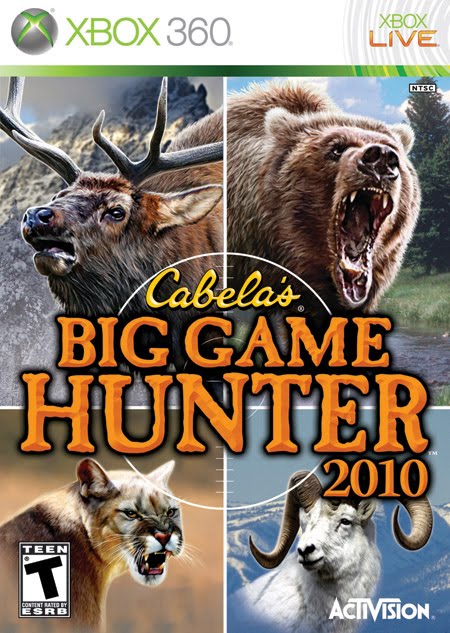
If you have ever wondered what it is like to track and kill a dangerous, man-eating lion or bear, you might want to look somewhere other than Cabela's Big Game Hunter for a realistic look at it. Despite the outdoorsman cred the Cabela name adds to the title, there is very little to this hunting game that feels remotely accurate.
Hunting seems like a genre screaming for first-person view so you feel as through you are right there. Instead, Big Game Hunter pulls you out of the equation; giving you a third-person perspective and a grizzled hunter character to control. It gives the game a tiny bit of a story, but a hunting game does not need a narrative or story to explain why or what you are doing. While wandering around the landscapes of Montana, British Columbia, New Zealand, and Africa, you will notice ever-present crosshairs in the center of the screen. The sights turn red when on an animal, and pulling the left trigger pulls up your scope view for a better look at the animal. Someone has evidently taken a census of each area prior to your arrival, because each animal you have your crosshairs on instantly lists a highly detailed description of it; including weight, age, and sex.
Animals are abundant in the game, but you will have to show some restraint. The one piece of realism the game provides, outside of your gear, is the need for hunting tags. You will get either tags or permission for each animal you kill. The game will offer warnings for animals you do not have permission to kill, but after the third 'mistake', it is game over. When you do have tags for an animal, after you shoot it, your 'adrenaline' meter goes up. It seems strange the first time you see it, and eventually proves to be downright asinine. After racking up a few animals, your meter becomes full, and you are ready to press the left bumper to use it.
When you use 'adrenaline', everything except your gun stops moving. This turns animals, quite literally, sitting ducks. The effect is exciting in action games, like Stranglehold and Max Payne, but that is because there are enemy bullets to dodge. No such danger in Big Game Hunter exists, making it an unnecessary, unsportsmanlike gimmick. It is even less a necessity when you start noticing just how eager the animals in the game are for their 'big shot'. All too often, animals stop and pose for you to shoot them while they stare at you. There are plenty of moving targets for you to shoot at, but they never seem too interested in getting away from the area; choosing instead to alternate twenty-seconds of running with five-seconds of standing still.
If that does not make your hunts easy enough, animals are not only unfazed by the ringing gunshots as you take down one of their brethren; they seem intrigued by it, flocking in mass towards your area. If there is one element of hunting that should remain realistic, it is that animals are scared of people and loud noises. Somehow, the developers loose track of this simple fact of nature. The result is swarms of animals to shoot at and the occasional animal that will readily walk right past you as though looking for food.
In the rare event that you are unable to find any of species you need to shoot, you have a few helpful tools at your disposal. The most realistic and common sense of them is your inventory, which contains hunting tools from duck calls to fighting antlers to species specific scents to draw in your prey. The other 'weapon' at your disposal is 'hunter sense'. Not only do the developers think that your father was Keanu Reeves in The Matrix, they believe that your mother was the alien in Predator. A half-Neo, half-Predator lovechild sounds like an interesting scenario for a game, but it makes a mess of a hunting simulation. Pressing the right bumper unveils your 'hunter sense', and changes the landscape to a strange black and white heat-sensing mode where you mysteriously 'know' where the animals are hiding.
The game replaces the patience required for finding animals to hunt with an incredible amount of pointless walking from spot to spot. Frequently, you must walk from one spot to the next to talk to someone about your hunting. When you get there, the person will ask you to go hunt some specific animals with tags they provide. The animals in question are typically right back where you started. The game adds these annoying little treks through the wilderness as a way to extend the gameplay, which still clocks in at only three hours for all hunts. It stretches gameplay to the point it is half-hunting, half-hiking simulator.
The walks would not be so bad if it were not for terrible level design, forcing you to stay exactly where the developers want you to at all times. The shortest path may be a straight line, but that would leave the game in the two-hour range for game time. Instead, the developers make impassable obstacles like a flower or small shrub, leaving your hunter unable to walk through, even though you just climbed up a steep hill and climbed a ninety-degree rock wall. The walks from one location to the next are still manageable thanks to your map, unless you are playing on 'expert' difficulty, where the game's idea of an 'expert' hunter is an unprepared one. Each map makes it look like your hunting area is huge, but it is easy to walk from one side of the map to the other in a few minutes, even with the constant 'impassable' flowers and shrubs.
You are never required even to call someone to collect your animals, perhaps because they disappear on their own after lying on the ground for thirty seconds. Mind numbing repetition replaces the mundane tasks of hunting. Each 'season' plays the same. Immediately speak to someone to get tags, learn that you need to shoot a few of animal 'A' before they will give you tags for animal 'B'. Complete both, while taking out a handful of birds along the way in optional mini-games, before finally getting to take out the area's 'trophy' animal, which has been conveniently marked as such on the previously mentioned census.
If you are lucky, something that can actually kill you attacks you just before you leave. These bits of excitement are 'rival hunt' events, and happen unexpectedly at the end of a few seasons. Each plays out nearly identical, with a large, dangerous animal trying to make you his dinner. You have to keep an eye on where the animal is at all times. If you are facing the right direction when they are charging towards you, the game flashes a message asking you to hit either B or X to dodge the attack. Hit the button in time, and your acrobatic hunter gets to his feet with the animal growling fiercely, and conveniently standing completely still, for about ten seconds. Since these are not your ordinary deer or water buffalo, they take around eight to ten shots to defeat; with yourself defeated if you fail to dodge half-dozen attacks.
Though the difficulty ramps up slightly as you shoot your way through, it is a ridiculously easy game that makes you long for hourly rentals. Despite the fact that the trophy animals are eventually grazing with other similar animals, and the fact that smaller animals are rough to spot in the winter, the game still clocks in at well short of earning even your rental dollars. With the career mode over so quickly, the game only offers the opportunity to start over or play ultra-brief 'quick hunt' modes in the same environments, though this time with only one animal to tag.
The game is graphically inept. Animals look like bad wax museum copies of themselves, often looking bad enough that it is possible to confuse a tree stump and a deer from one-hundred yards out. The hunting locations fare a little better, but the game suffers from technical issues that causes items to render too closely to you. It often appears as though grass is constantly growing a few feet in front of you while walking. The human models look decent enough, but your hunter frequently suffers from jittery animations that leave you questioning whether he should really be handling a gun. Sonically, the game receives better voice work than it deserves. There is not much in the way of speaking, but at least they got the accents right for the different countries you visit. The ambient noise is cranked up a bit too loud, often sounding as though you are hunting from the middle of your local zoo's birdhouse.
At least you will not be plugging away for hours in search of Achievement Points, although the game seems to muck up even this small task. The one-shot kill achievements on the trophy targets is either badly broken, or the game refuses to count badly missed and non-lethal hits. At least this is in your favor, unlike the long-shot Achievements, which seems to ignore the fact that the maps themselves are limited in space, not counting the terrain that prevents you from scoping an animal from that far.
Cabela's Big Game Hunt is fails to deliver on all fronts, failing to provide a realistic hunting simulation or at least compelling gameplay.
About a year ago, Criterion Studios launched Burnout Paradise for the Xbox 360, a stellar addition to the popular Burnout franchise. The game took the series in a great new sandbox direction, offering a large city to explore and new missions to take on however the player wanted to. Additionally, the game featured some pretty nice multiplayer features, allowing players to drop into the same environment and either take on driving missions or simply mess around within the game’s environment. However, the game was lacking in one area: it didn’t allow for more than one player on the same console.
With the newly released Party Pack, EA Games and Criterion Studios are looking to breathe some new life into the year-old game. Burnout Paradise: The Ultimate Box is a compilation of the original game and the new Party Pack (which is also available as DLC via Xbox LIVE for previous owners of Burnout Paradise). While the original game is mostly just as you remember it (save for a few nice new additions, but more on those in a bit), the new Party Pack feature is actually a pretty fun new element to the game’s multiplayer component. While the Party Pack isn’t likely to turn you into a fan of the game unless you already were one, it’s still a nice touch.
Instead of going into the pros and cons of Burnout Paradise, I’ll instead direct you to our review of the game from last year (http://xbox360.gamezone.com/gzreviews/r30639.htm). The rating still stands today, as Burnout Paradise was and still is one very ambitious and engaging racing title.
There have been some new improvements implemented into the original game, like the ability to restart an event, which is an addition that was way overdue. Additionally, the Ultimate Box features not only the new Party Pack, but the Cagney and Bikes updates on disc as well.
The Party Pack is basically a multiplayer suite that allows up to eight players to engage in several pass-the-pad style games that only require the use of one controller. You begin Party mode by selecting the number of players you want to play as, and then customizing them with their own name and photo, if you have a USB camera hooked up to your Xbox 360.
Party mode is divided into three different game types: Skill, Stunt, and Speed. The event types are pretty self-explanatory, as Skill events require you to drive dexterously and perform drifts and other technically impressive moves, Stunt events require that you perform tricks like barrel rolls while in air, and Speed simply requires you to make the fastest time. There is a real random feel to the Party mode, as you aren’t able to choose your specific events nor the win conditions as you play, which could help newcomers take on seasoned vets in different situations.
As the added Party Pack feature is available as a free download, there is no reason for current Burnout Paradise owners to pick up the Ultimate Box. Additionally, the Ultimate Box is only available at European retail, meaning that US gamers will have to settle for buying the original game and downloading the new content from Xbox LIVE. Still, the original Burnout Paradise is still one of the premier racing titles on the Xbox 360, and the new Party Pack download is a nice touch for those looking for a reason to pull their copy from the shelf for some multiplayer action.
Review Scoring Details for Burnout Paradise: The Ultimate Box
Gameplay: 8.5
The basic elements of the gameplay haven’t been changed much from the original title, but the new Party mode is a nice addition to the already stellar racing title.
Graphics: 8.5
Pretty sharp graphically, but no noticeable difference from the original game.
Sound: 8.5
Unchanged from last year.
Difficulty: Medium
Concept: 8.5
The Party Pack takes an element that was sorely missing from the original game (same-system multiplayer) and implements it well.
Multiplayer: 8.5
The Party mode finally allows up to 8 players to take each other on via the same system, and the random nature of the events works well in party situations.
Overall: 8.5
If you aren’t a fan of Burnout Paradise, then the Party Pack won’t change your mind. However, if you’re looking for some fun, new multiplayer elements (not to mention free), then give the Party Pack a download. Additionally, if you skipped out on Burnout Paradise altogether when it released last year, then the Ultimate Box is a worthy investment.
Leggy heroines have long been used to move shoddy games into the hands of unsuspecting teenage boys. Some of them, like BloodRayne, even get bad movies built around the female form. Meet Bullet Witch, the latest entry into that category. This one features the lovely Alicia, a witch with a gun that looks like a broom. She's the quiet type with a dark past and a desire to wipe every demon off the face of the earth. Unfortunately, the game built around this premise didn't turn out so well thanks in large part to the spotty engine it was built on.
The campaign to save the world follows Alicia through a grand total of six stages with the last one taking place in the same environment as the second. If you don't get stuck on any of the frustrating parts, you can finish Bullet Witch in 3 or 4 hours. As you might be guessing by now, there isn't a lot to see here. To be fair, there will be several downloadable packs on Xbox Live that will include several new missions and a costume in each one, though only the first pack is slated to be free.
The six levels in Bullet Witch are fairly standard and don't offer anything you haven't seen before. The first few send you down city streets and through tunnels, seeking out floating brains known as Walnut Heads to kill and remove magical barriers in your path. Things begin to open up a tad in the latter levels as more and larger monsters are sent to take you down. Each stage features a bit of environmental interaction to amuse you in the form of destructible items and buildings, ceilings that you can cause to collapse and the like. Along the way, you'll gain some nifty magic tricks that can serve to deliver some of the best moments in the game and a quartet of gun options to give you new play style options.
Sniper enemies are the most annoying foes in Bullet Witch.
The magic powers that Alicia has at her disposal are the only thing that gives Bullet Witch any distinction over the myriad of other third-person shooters. There are three greater powers (lightening, tornado, and meteors) that are used to create the most damage and visually pleasing moments. The latter two are only available at the very end of the game and even then are not put to good use. Aside from that, there are a few lesser powers that are primarily used simply to mix things up. Unfortunately, the system for calling up a spell is unwieldy and frustrating. Rather than allowing you to hotkey your favorite spells, you have to cycle through the list by pressing the bumper buttons. Once you've cast the spell, the game will go into an animation that will cause your targeting reticule to move, making it a chore to aim the longer spells properly. If you're hit while selecting or casting a spell, it gets canceled and you have to start over. When you do get your spell off, the animation causes you to freeze in one place for a few moments which will often cause you to get killed. It's annoying and after a few hours of playing we wound up ignoring the spells and just running around with the machine gun equipped.
Games where you run around and mindlessly shoot demons can be fun, but the engine Bullet Witch was built on just doesn't cut it. The collision detection seems almost random at times, often causing things to kill you for seemingly no reason at all. If an explosion goes off and sends a car flying by you, the game will often read the projectile as hitting you. This invariably ends your life and causes you to curse at the screen and question your sanity. Falling objects must be avoided by 10 yards or more; standing too close may cause your death. Or the falling object might clip right through you and leave you in one piece. It's like playing rock-paper-scissors, but everybody always loses and you'll constantly be left wondering why.
The clipping issues also cause you to have a whole new outlook on the way things work. Enough play time makes you forget that people floating several feet off the ground with their back stuck partway through the wall should be seen as an oddity. Chain link fences can be seen through, but act as a wall to bullets. That is, of course, unless you get close enough for your gun to clip through the wall. Or sometimes the bullets will just fly through what you thought was a wall, or any other object, as if it wasn't there.
Further preventing you from having fun is the sorely lacking artificial intelligence. Demons in Bullet Witch enjoy running face first into a wall, ignoring you while you shoot them, or standing in one place firing at you. Occasionally they move. Just jumping through a level is enough to confound the enemies making it possible to just bounce through large stretches of the game. When you die, it isn't because you were outsmarted. Instead, death comes most often from random occurrences produced by the physics engine or flat out cheap enemies that are thrown at you out of the blue.
Keep your distance when these guys start falling.
All told, the work Atari did bringing Bullet Witch to the US turned out quite well given the source material. The voice acting during the cutscenes is decent in a tongue-in-cheek sort of way. Even the signs reading, "Sorry, mirrors were removed," that were slapped on the bathroom walls in lieu of mirrors as an excuse for Bullet Witch lacking reflective surfaces are funny once you get over the fact that the game doesn't look all that great.
And don't be fooled - Bullet Witch is not pleasing on the eyes. The shadows are pixely where they exist and the general enemy design and environments are uninspired at best. This game may not have appeared bad when it came out in Japan last summer, but we have since seen a plethora of visually stunning titles and comparatively, Bullet Witch doesn't hold up. The sound samples, too, end up feeling a bit lazy. While the voice acting provides a few chuckles, the death screams and constant droning of the gun get mind numbing after a short while.
The saving grace, if there can be one, of Bullet Witch is the ending. Not the final boss, which incidentally was designed beyond the limits of the engine and produces massive slowdown at points that should be climactic. Nor is it simply the fact that the game is over. No, the end cinematic is by far the greatest part of Bullet Witch. We won't spoil it for you, but know that it is hilarious.
Double Fine's Brutal Legend is an unabashed love letter to an era and genre of music that celebrated fast guitar riffs and hard living. It's also a tribute to an epic lore that spoke of conquerors and death--all of which were often depicted at once on any given metal album cover with the obligatory smattering of lightning. Of course, the fact that Brutal Legend features a phenomenal soundtrack from the likes of Black Sabbath, Motorhead, and Judas Priest with suitable hack-and-slash action would feasibly constitute a reasonable tribute on its own terms. Yet, what raises Brutal Legend above that simple construct--plus what makes it a great ode to metal--is how it cleverly integrates so many different facets of the culture and its music to create an experience that consistently entertains and surprises in both single-player and multiplayer.
But it should come as no surprise to those familiar with Double Fine's previous work with Psychonauts that Brutal Legend's characters and its story are the primary highlights. Eddie Riggs, a roadie who remembers and worships the glory days of metal, serves as a perfect lead character who's magically transported to a world that ostensibly reflects his own image of heaven. This world is a vast place where enormous, crumbling statues and smaller, skull-encrusted shrines pay homage to the gods and titans that brought metal and its music to the land. Naturally, there's a heavy dose of irony involved in this setup, which gives Jack Black (who voices Riggs) plenty of room to do his funny--albeit expected--trademark sarcasm-laden, observational routine. But his act rarely gets old or overwhelming because Riggs, as a character, often humbles himself in an endearing way despite finding himself in a position of leadership. He never loses sight of his roots as a roadie, and as such, he is there to help people who have fallen under the oppressive boot of the demonic Emperor Doviculus and his human warlord General Lionwhyte (voiced by Judas Priest frontman, Rob Halford), who also happens to symbolize a not-so-subtle jab at hair metal.
Secondary characters are often just as entertaining and memorable as Eddie Riggs. Ozzy Osbourne gives an amazing (and surprisingly coherent) performance as the Keeper of Metal, a storekeeper of sorts dwelling within special monuments dotted around Brutal Legend's open-world landscape. He sells upgrades for attacks, as well as Eddie's various pieces of equipment, including his battle axe, guitar, and his vintage roadster--the Deuce. There's an equally amusing, if not subdued, performance by Motorhead's lead singer Lemmy, who--as The Killmaster--functions as a healer for Eddie's army of headbangers. Sure, part of what makes these characters so delightful is that they are just fantastical representations of their on-stage personas, but even those characters that aren't voiced by real-world gods of metal do their part to balance out the star power, and they do it well. For example, Magus, a dimwitted stage engineer, provides an extra bit of laughs when Eddie's engaged in more serious affairs.
These characters and the story they tell are major reasons to keep playing through Brutal Legend's single-player campaign, but there's also plenty of good action to be had despite some shortcomings. The game is set up in an open-world structure that lets you set the pace of progression, so you can either stick to Eddie's main mission to defeat Doviculus and Lionwhyte or drive around in the Deuce to find secondary missions with the help of an in-game map. At first, the motivation for taking the secondary route is pretty clear. Every completed mission rewards you with fire tributes, or points, that function as the game's currency, and because secondary missions are usually pretty easy and don't require much time, this is a quick way to make a substantial amount of cash. You can then visit The Keeper of Metal and exchange points for aforementioned weapon, combination, and vehicle upgrades--additional items unlock as you venture deeper into the game.
But at a certain point, perhaps even just a few hours in, the motivation to engage in Brutal Legend's equivalent to level grinding wanes, and the reasons are clear. First, most secondary missions share the same objectives, so it doesn't take long for all of the ambush, race, and defend-this-point scenarios to get old. Secondly, you can purchase most of the useful upgrades relatively early in the game, which makes these missions even less enticing. In fact, by the end of the game, you may find yourself purchasing upgrades just to check them out, never to use them again. There are some exceptions to the tedium in the secondary missions, though, including a run-in with a bat that has a human head resembling Ozzy Osbourne in his earlier years, but Brutal Legend's side missions would've benefited greatly from more of these kinds of scenarios and fewer of the cookie-cutter options.
Conversely, its primary campaign does a much better job of breaking up different mission types and mixing in action that plays to its different mechanics. Granted, there are a couple of dreaded escort missions where you have to follow your army's tour bus from one location to another while fending off enemies, but these aren't all that difficult as long as you keep an eye on where enemies spawn. Eddie also has to go on foot into unknown areas for some missions, relying only on his axe for close combat and his guitar for long-range lightning and fire strikes. It's in these moments that you also learn to use some of his other skills, specifically guitar solos.
These solos, which you can unlock by finding shrines, function as special moves for Eddie. They allow him to melt faces of nearby enemies, recruit new army members, negate an enemy's magic abilities, or even summon a massive burning zeppelin to crush enemies. Of course, you actually have to get the solo right (each solo has a different, miniature rhythm-game-like series of button presses), but the trick is that you can't use these solos all the time (some of them have a long cool-off period) and Eddie still takes damage from enemies while performing them. This adds a nice dynamic to an otherwise straightforward combat system, and the missions (along with their accompanying boss battles) where you have to rely on Eddie and his combat skills are thoroughly enjoyable, but it would've been great to have more of them.
Instead, Brutal Legend replaces what would ordinarily be more of these kinds of missions with stage battles--a recipe with hack-and-slash and real-time strategy as its ingredients. A good portion of Brutal Legend is a real-time strategy game, and surprisingly, it's one of the best console adaptations of the genre's mechanics in quite some time, though its multiplayer incarnation is definitely better than its single-player counterpart. To give some context: Stage battles usually occur when facing an important evil character in the game. Each side has access to what are essentially fountains of fans that you need to build merchandise booths over (by playing a guitar solo) in order to claim them as a resource for building additional "units." Building more merch booths and claiming more fans lets you not only summon more units, but also different types of units.
You can control these units in different ways, either by using various commands on the D pad (defend, attack, and move) or by taking to the air and setting waypoints via a marker that you can place just about anywhere in the level--a highly recommended move because it gives you a better overall strategic view. And yes, Eddie grows wings that let him fly and survey the battlefield, but in either case, you still have to be reasonably close to your units to issue these commands and ultimately make your way towards the final goal of destroying the enemy's stage. The single-player version of these battles does an excellent job of tying all of Brutal Legend's gameplay elements together in a real-time strategy scenario, barring some minor context-sensitive control problems with double-team moves when there are too many units crowding around you.
Still, aside from the final confrontation, most of these stage battles are won through brute force--making a mad dash for all of the fan fountains and throwing wave after wave of units at the enemy is usually enough for a victory on normal difficulty. But multiplayer stage battles are completely different beasts that require far more skill and strategy--trying to win these matches through strength alone often results in complete failure within minutes. In fact, these battles almost become games of chess where fan fountains and merch booths become the pieces on the board. You use some of them to advance and strengthen your forces while you sacrifice others to the enemy for the same purpose.
Indeed, diversionary tactics also play an important role for success because another player can easily drop in and see what you're doing at any given time. As such, it's important to send out different groups of units to various areas on the map at all times, using one to bait your enemy into thinking that's where your main attack is coming from while you have a stronger group of units taking another route. Sometimes it's worth it to throw a few units directly at an enemy's stage or to drop in yourself and wreak some havoc and fly back to safety; if only for distraction purposes while you adjust your strategy. And the great thing about all of this is that you can play as one of three different factions--each with wildly different units--and an evenly matched battle shouldn't last more than 20 minutes or so.
While multiplayer is genuinely the surprise hit of the Brutal Legend experience, the single-player mode does have many other notable qualities, including a great metal soundtrack. Some of the songs seem a little questionable given the theme of the game ("Rock of Ages" is a great song, but doesn't seem like it belongs), and it's great that you can listen to anything while driving the Deuce around. But the soundtrack truly shines when it's obvious a specific song was chosen for a specific mission. "Through the Fire and Flames" by DragonForce is perfect for its intended sequence as is Nitro's "Machine Gun Eddie." There's a little bit of everything here on the spectrum, but to be fair, if metal's not really your thing, you might find it a little grating.
But one thing that should appeal to just about anyone is Brutal Legend's visual style. It's not necessarily a technical powerhouse in terms of special effects, but it more than makes up for it with cool-looking characters and varied environments that obviously had quite some thought and detail put into them. One particularly cool location is near the Sea of Black Tears--a gothic-inspired area decorated with candelabras and dilapidated cathedrals. But no matter where you are in the world, there's always some cool object to look at, whether it's a massive guitar statue sticking out of the ground or some a gigantic wall of amps where seagulls with microphones for heads fly. Unfortunately, there are some hiccups in the frame rate here and there, particularly when you're driving around or when there's a bit too much happening in a stage battle, but otherwise it remains rock solid throughout the game.
Whether it's excellent vocal performances from heavy hitters of metal or a strong multiplayer element, Brutal Legend is a game that continually surprises, and it does so in a genuinely fun and interesting way. And Double Fine deserves some major respect for keeping so many aspects of the game closely tied to its subject matter. Of course, Brutal Legend also has some shortcomings. The secondary missions are weak and the single-player campaign lasts about seven hours if you're not too keen on unlocking every single last shrine or secret item. In that respect, it's unfortunate that there's just not more of the good stuff, such as the on-foot missions with boss battles or more fleshed-out side quests. Otherwise, Brutal Legend is just about the finest tribute to this genre of music that a fan could hope for, and its successful execution of real-time strategy elements in an action setting is something that should get everyone off their feet and clapping.
You're still playing Borderlands, right? If so, the Zombie Island of Dr. Ned, the first downloadable content for the game, should be of interest. For $10 USD you get a whole new zone with a bunch of new quests, enemy types, and opportunities to snag more loot. Wrapped up in Halloween themes, the Island also sticks in the mind more easily than other zones in the game. There's still plenty of rocky ground in this setting, but this area's greener, filled with trees, is built with more personality, and also happens to be filled with zombies.
Anyone disappointed with the meager story threads laced throughout the original product will find this narrative in Jakob's Cove to be more sturdily strung together. It's still nothing incredible, but the bubblegum tale is packed with humor, cultural references to things like Scooby Doo and more that should keep you entertained. Like the zone itself (accessible via the fast travel menu), the tale is separated from the main game, as it doesn't really tie into the Vault story and therefore loses any semblance of seriousness, which works to its advantage.
To go along with the goofball humor and "spooky" motif, you'll see lighted pumpkins around the area, pumpkin-headed bosses, angular and eerily lit houses, and fields of ghoulish foes. None of the enemies in the zone carry any guns, but they do attack in large numbers. The standard zombies pop out of the ground and shamble directly at you, and if you're not paying attention it's easy to get overwhelmed by their numbers. This is especially true if you happen to run into spitter zombies that can blur your vision with putrid projectiles, or hulking Frankenstein's monster-like creatures that can initiate a number of special attacks like ground pounds and lighting bombs. Oh, and be sure not to hit these guys with electrical elemental damage…it turns out to be a little counterproductive. Though it's still a far cry from the type of excitement and tension delivered by the zombie battles in Valve's Left 4 Dead, the conflicts here are still interesting enough if only because you're still gaining loot and experience after every kill. It feels almost like playing something like Painkiller since there are so very many enemies at once, and most types prefer all-out attack to taking cover and firing from afar.
More enemies, and new boss types.
For quest content you'll have a handful of main story missions involving Dr. Ned and his undead experimentation along with a bunch of side quests. Many of these quests involve the same kinds of MMO-style goals you're familiar with at this point: kill these four things, find this many voice recordings, or go meet with so and so. In that sense, mechanically this DLC just offers more of what you're used to doing in Borderlands. It's a good buy in that sense if you're still progressing toward the level cap, but there's little reason to dive into this with a max level character class. For me, I tried out the DLC on Playthrough 1 after completing the main story and found the content to be set around mid the mid to high 30s. In Playthrough 2, where my character was much earlier on in the story, the enemies of the zone were set at early to mid 40s, so you'll want to consider where you are in the overall progression before taking the trip.
Don't let that dampen your enthusiasm for this content. Since the enemy types are new and some of their behaviors differ, there's a different kind of feel to the play here. In the end you're still mowing down everything you see, but doing so has its own kind of flavor, and considering the amount of content offered here you can expect to spend a while exploring and slaughtering. There aren't any vehicles, so this isn't built as a sprawling, wide-open zone, but its fetid pools and fields of mossy rock are packed with foes so every few steps you can expect to be assaulted. Frequently as you leave areas you'll have blasted apart so many enemies there the ground will be blanketed with loot, which in games like this is a very good thing.